They want to transform the food market with an app, and they already have success stories
María Fernanda Bonesso is 35 years old and was born in Maipú, Mendoza, into a family of small fruit growers. She studied Economics at the National University of Cuyo, and her professional path took her into other fields…
Published in Agrofy News on November 5, 2021
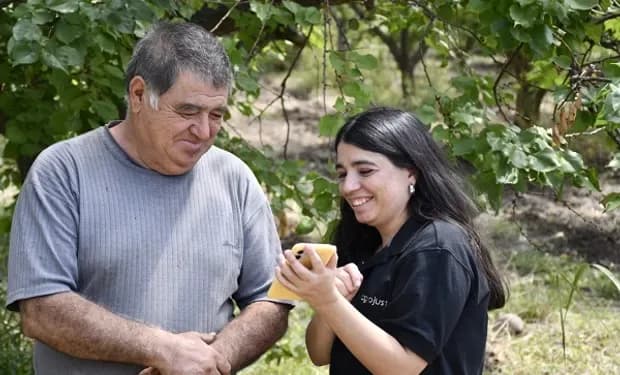
María Fernanda Bonesso is 35 years old and was born in Maipú, Mendoza, into a family of small fruit growers. She studied Economics at the National University of Cuyo, and her professional path took her into other fields, far from agriculture.
“As a girl I helped out with the family business, but I didn't see it as something to work in in the future; I think that happens to other young people too,” she said in an interview with Agrofy News.
She received a Fundación Carolina scholarship in Spain to specialize in Finance while working at a bank. She then continued her studies in Buenos Aires, where she completed a Master's in Economic and Financial Risk Management at UBA, and at Di Tella, where she studied Applied Economics. However, despite that impressive professional track record, she wasn't satisfied: “Nothing quite felt right, and I decided to come back,” she said.
Agrojusto, the revelation: from the land to the market
Every year in November, at harvest time, María Fernanda's father faced the same problem: the sale of his apricots. “All producers face the same thing: they don't know who to sell to or where, or they have to accept having all the terms of sale imposed on them in a one-sided process.”
“When I lived in Belgrano I'd walk past the greengrocers and see the prices of apricots. I understand that logistics costs are very high, but seeing producers throw away what they've grown because nobody wants to buy it at that price is crazy. That's when I decided to do something to change it,” the entrepreneur said.
María Fernanda felt she had to find something that would allow her to bring about change: “At the end of 2017, when the first tech ventures like Pedidos Ya and Uber started to boom, we thought we had to create something similar to solve this problem.”
When she returned to Mendoza, she pitched the idea to her partner, a tech entrepreneur with a background in agriculture, and to a friend of theirs who is a web developer, and they got to work: “We understood the problem but didn't yet know how to solve it. We started researching and saw that in Colombia there were some startups tackling the same issue. That's when we realized that this was happening in other parts of the world too.”
See also: A fintech created an alternative financing model for small producers
Agrojusto's key link
That's how Agrojusto was born in 2018: a startup that aims to connect small farmers and cooperatives directly with consumers, reducing intermediary costs. The platform helps producers create their own online store to sell their food themselves, and they can also manage home deliveries and add payment methods.
“At first we wanted to eliminate intermediaries; then we realized we wanted to remove the ones that didn't add value, so that producers could sell. We started talking about commercial managers, like cooperatives, that help place that product alongside other products. We reduced intermediation costs; we didn't strictly eliminate them,” Bonesso explained.
Their first boost came when they won an INTA competition. “Lots of entrepreneurs innovating in family farming took part, and we were among the winners. That's when we had our first app,” said María Fernanda, CEO of the startup, whose team also includes Ignacio Lemmo (CTO), Nelson Pérez (CIO) and Matías Lambrese (COO).
Subsequent work to expand their reach earned them the support of the Center for the Implementation of Public Policies for Equity and Growth (CIPPEC) and BID LAB, the innovation lab of the Inter-American Development Bank, which currently fund the initiative.
Technology partners
Since 2020 the four entrepreneurs have been working full time on the project, and the platform has been up and running for about 4 months. “We saw results right away. We digitalized retailers in Buenos Aires, and thanks to AgroJusto they are finding almond suppliers who signed up to the platform. It's very rewarding to see these things happen,” the entrepreneur said, by way of example.
Its business model is based on offering technology to farmers, entrepreneurs, associations and cooperatives so they can connect with end consumers: “There are more than 300 producers and more than 500 stores. We reached this number by building alliances, and we know the platform can deliver much more. We're facing the challenge of growth, of fine-tuning and perfecting processes. We're also looking for investors who believe in this vision,” she revealed.
They soon realized that the heart of the business had to be synergy: “We decided to be technology partners for organizations and individual producers, taking them to another level. Not overlapping in tasks, but empowering players that already exist,” said AgroJusto's CEO.
That decision proved to be a wise one, and they are having great success partnering with organizations such as Sabe la Tierra, which has been working with producers in Buenos Aires for over 12 years and reaches more than 25,000 consumers: “With the pandemic, they were left unable to sell. We provide them with sophisticated technology that would be impossible for them to build on their own because of the cost and know-how.”
“Being technology partners is what sets us apart from other kinds of agtech startups. We scale with technology. Growth is slower because it requires bringing technology into segments that aren't very tech-savvy, but it's a deeper change,” the entrepreneur explained.
Working with young people
To illustrate it better, AgroJusto's CEO explained that it's like a “Tiendanube” specialized in small producers that also has an internal marketplace: “Today we're betting that any player, whether a producer, a store or a cooperative, can set up its own e-commerce technology with support in the digital sale of food. At the same time, this same platform has producer data built in so they can source their supplies, and that's when a network is created and we connect the chain.”
The platform has national reach. “We have strong ties with Misiones, Jujuy, Buenos Aires, Córdoba, Mendoza, Chaco and Entre Ríos. We rely heavily on young people, who are the ones who get things done. We train producers' children so they can lead the transformation. That's how we're changing the model of market access and sales.”
First results
María Fernanda explained that, to support producers, they work together with UNCUYO, where design, communication and agronomy students take part, allowing them to train those who need it and to scale.
“Our added value is offering a hands-on, up-close experience. We're there and we understand the problems that come up. Today we're focused on household consumption and on small food producers, so they can make the leap from an artisanal channel to a digital one.”
Last year, thanks to AgroJusto, although her dad couldn't sell all 30,000 kilos of apricots, he “managed to sell part of them directly and reach other buyers; he's diversifying his market, and that's progress,” she explained.
“Every day people thank us for being able to close a new deal or for getting over their fear of selling online,” she added.
The story of “the settler”
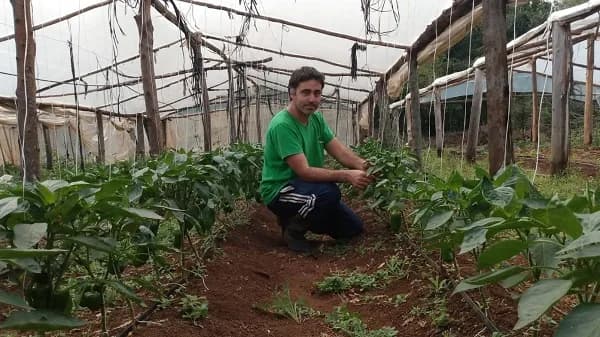
Fernanda shared a success story from Misiones. Gastón Jacobi is a farmer from Gobernador Roca who sells at the Villa Cabello farmers' market. He calls himself “the settler” because of his work: “He went through a webinar program we had implemented with the Misiones Ministry of Agriculture and Silicon Misiones, and from the very beginning he got the message, created his online store, asked our team for advice and started selling online within two or three weeks,” Bonesso said.
“He goes to the markets with his produce already sold and looks for extra sales, but he doesn't depend on that. It greatly changed his profitability. He's our early adopter. He loves this whole process and we're captivated by his progress,” she added.